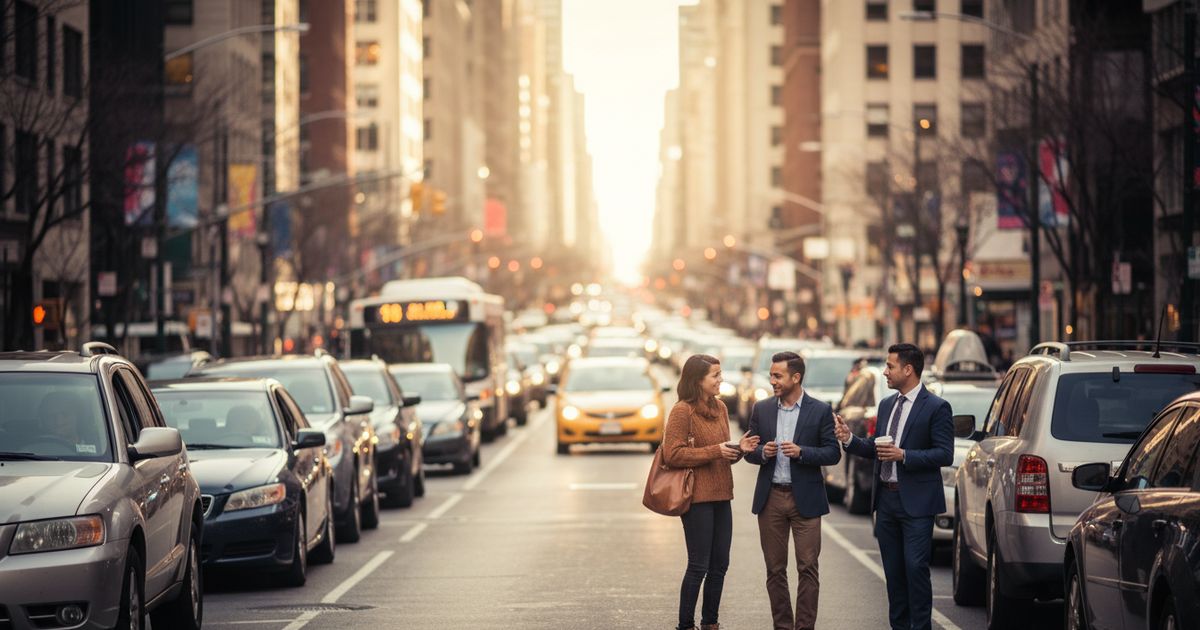
Every car on a commuter route carries a seat or two that nobody uses. Carpooling is a simple way to fill some of those seats, which means the same number of people can arrive in fewer cars. This post explains in principle how that can ease pressure on roads and parking lots, shows a small modeled example, and is honest about what carpooling cannot do by itself.

The basic idea: same people, fewer vehicles
Roads and parking lots are built around vehicles, not people. A lane carries cars, and a parking space holds one car for the day. If two coworkers who live near each other share one car, the lane carries one vehicle instead of two and the lot needs one space instead of two. Nothing about their destination changes. Only the number of vehicles does.
This is why carpooling is often described as a way to use existing capacity better. The roads and lots are already there. Sharing makes fuller use of the cars that already travel them.
A modeled example: cars per 100 commuters
The numbers below are a hypothetical example with the arithmetic shown. They are not measurements of any real roadway or workplace.
Imagine 100 commuters who all drive alone to the same office district. That is 100 cars on the road and 100 parking spaces needed.
- Baseline: 100 commuters, 100 cars.
- 10 commuters share two to a car: they use 5 cars, and the other 90 use 90. Total 95 cars, which is 5 fewer.
- 20 commuters share two to a car: 10 cars plus 80 = 90 cars, which is 10 fewer.
- 40 commuters share two to a car: 20 cars plus 60 = 80 cars, which is 20 fewer.
In this example each commuter who joins a two-person carpool removes half a car from the road and half a space from the lot. If some groups travel three or four to a car, the reduction per person would be larger.
Parking demand is where employers feel it first
Parking often matters more to an employer than road traffic, because spaces are a fixed number. Building or leasing more costs money, and a full lot can make the morning stressful for everyone. If, as in the example, 20 commuters share rides, 10 spaces are freed. Whether that is meaningful depends on how tight the lot already is. For an organization that is close to its limit, even a few spaces can be useful. For one with plenty of room, the benefit shows up elsewhere, for example in fuel cost for participants.
Why carpooling alone does not fix congestion
It would be unfair to oversell this. Several things limit the effect:
- Participation. Congestion changes only if enough people share, and many commutes do not line up in time and place.
- Timing. Traffic is concentrated in short peaks. Shared rides need to happen in those peaks to make a difference there.
- Empty seats. A carpool that runs only some days has a smaller effect than the arithmetic above suggests.
- Replacement. Some people who share may have used transit or walked. Their switch does not remove a car.
- Detours. Picking up a partner adds a little distance.
Carpooling is one tool among several. It works well alongside other choices, not as a single fix.
What cities and employers do
Because the effect depends on many people choosing it, cities and employers commonly try to make sharing easier. Examples of what they do include:
- Offering preferred parking for shared vehicles.
- Providing a way for coworkers to find partners.
- Supporting other options, such as transit passes, flexible hours and remote days.
- Counting commute modes in an annual survey to see what is changing.
Our post on how to start a workplace carpool gives a step-by-step plan, and finding carpool partners covers the matching part.
Why the effect is gradual
Traffic and parking change slowly with habits. A few early carpools may be barely visible on a crowded road, but they matter to the people in them and to the lot they use. As more coworkers or neighbors hear about a shared ride from a friend, the number can grow. The honest expectation is a gradual shift, not an overnight change, and measuring your own lot occupancy over a few months is a good way to see whether it is happening.
How an app fits in
A big obstacle is finding someone going your way at your time. In ShareSpace Carpool, drivers publish a ride with a route, a time and seats, and riders search by pickup, drop-off and time. Riders can book just the stretch they need, and drivers can add stops along the way. Prices are capped to the shared cost of the trip, so sharing stays about splitting expenses. You can read more in how car pooling works.
Frequently asked questions
Does carpooling reduce traffic?
In principle, yes, because fewer vehicles carry the same people. The size of the effect depends on how many people share and when they travel, so it is one part of a larger picture.
How does carpooling help with parking?
Each shared car needs one space for several people. In the example above, 20 commuters sharing two to a car free 10 spaces out of 100.
Are the numbers in this post real measurements?
No. They are a hypothetical example with the arithmetic shown, meant to explain the idea.
If you would like to put a few empty seats to use or find a ride that skips the parking hunt, try searching or offering a ride in the ShareSpace Carpool app.
Ready to carpool?
Download ShareSpace Carpool, free on iPhone and Android.